Dispatch #6: Out of the Lab
A beginner-friendly roundup of spring 2026 robotics news — humanoids leaving the demo stage for real factory pilots, plus a dexterous-hand milestone.
Welcome back to The Robotics Dispatch — the column where, every few weeks, we put down the soldering iron and look at what’s happening in the wider robotics world, then tie those headlines back to the basics you’ve been learning. No prior news-reading required; we explain the jargon as we go.
Last time, in Dispatch #5 on robots on the factory floor, we watched robots start showing up in real industrial workplaces. This time we follow that thread one step further: the recent news has been less about flashy lab demos and more about machines being delivered, deployed, and counted. The honest version of the story is messy — some of this is genuine paid work, a lot of it is still a trial — so we’ll keep the labels straight as we go.
The big shift: from “look what it can do” to “how many did you ship?”
For years, humanoid robot news meant a polished video of a machine doing one impressive thing once. The interesting change in early 2026 is that the questions got more boring — and more real. Buyers and reporters started asking about units shipped, uptime, and how often a human has to step in. Two milestones in the last couple of weeks capture that shift: a Chinese company quietly hitting a production number nobody else has, and a German carmaker putting a humanoid onto an actual assembly line.
First, a vocabulary note we’ll lean on all article. A degree of freedom (DoF) is one independent way a joint can move — your elbow has one (bend/straighten), your shoulder has roughly three. The more DoF a robot has, the more human-like and flexible its motion, but also the more actuators (the motors that drive each joint) it needs to coordinate. Keep that in mind; it’s the bridge back to your last few tutorials.
Lead story: AgiBot rolls its 10,000th humanoid off the line
The clearest in-window milestone came from AgiBot (also styled AGIBOT), a Shanghai-based humanoid company. On March 30, 2026 the company announced it had built its 10,000th humanoid robot, which The Robot Report and others covered as one of the first times any company has reached that number at scale.
Why does a round number matter? Because of the curve behind it. By AgiBot’s own account, it took roughly two years to build the first 1,000 units; about a year to go from 1,000 to 5,000; and then the jump from 5,000 to 10,000 took only about three months. AgiBot’s CTO, Peng Zhihui, framed it as “a fundamental shift in our ability to scale.” The research firm Omdia ranked AgiBot the top humanoid shipper of 2025, and the company says its robots are now working in logistics, retail, hospitality, education, and some manufacturing lines.
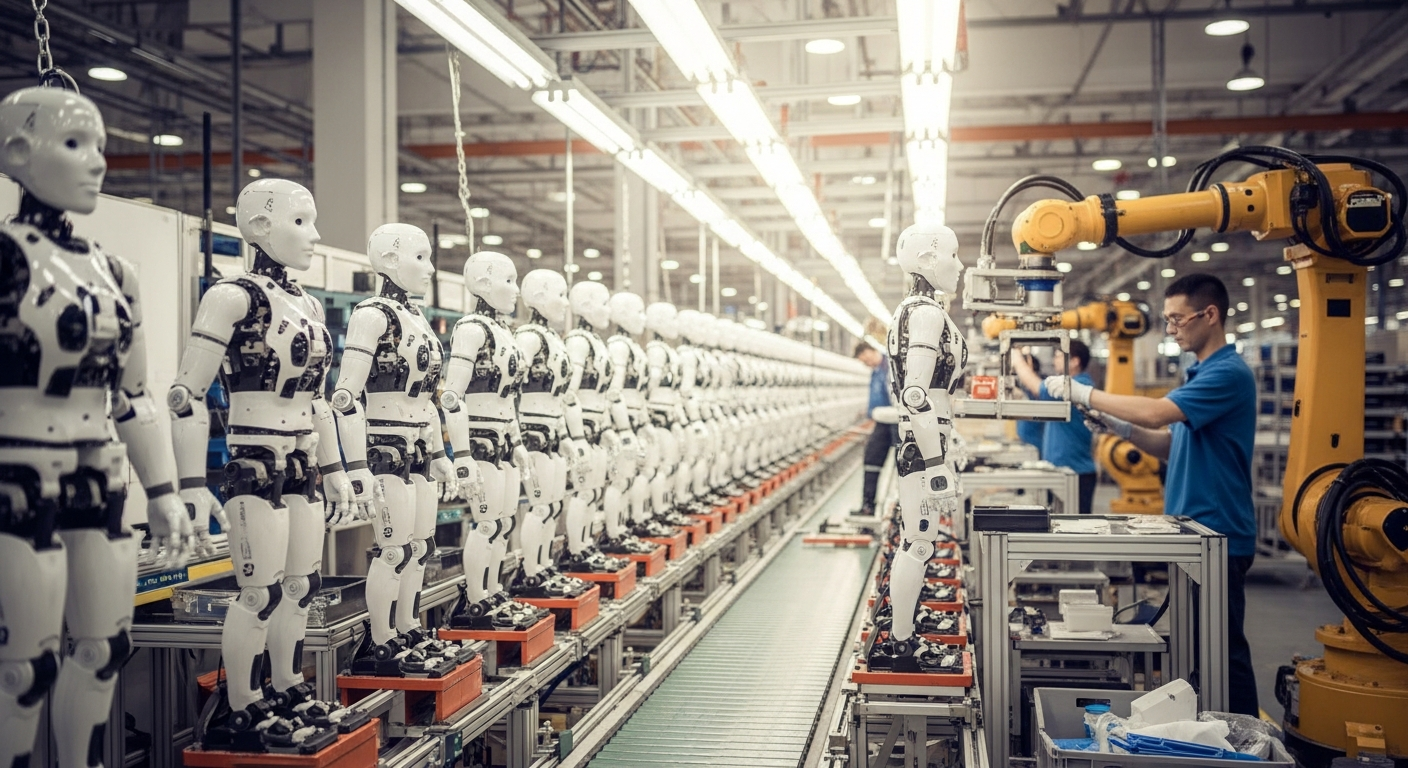
A fair-minded caveat: “built 10,000 robots” is not the same as “10,000 robots doing paid work in factories today.” Many of these units go to research labs, showrooms, and education, and a manufacturer naturally presents its own numbers in the best light. But even discounted, the manufacturing story is striking — building humanoids is starting to look less like hand-assembling prototypes and more like running a production line, which is exactly what has to happen before they become ordinary tools.
Connecting the dots: this is your servo tutorial, scaled up
A humanoid like AgiBot’s is, underneath the AI, a crowd of the exact components you just studied. Each joint in that stick figure is driven by a servo — and as we covered in servo motors, a servo’s whole trick is that you tell it “go to this angle and hold it,” fighting back against anything that pushes. A humanoid simply has dozens of them.
And how does each joint know it actually reached the commanded angle? That’s encoders — the sensor that reports a joint’s true position, the basis of the closed-loop control that corrects the joint when reality drifts from the plan. A robot that builds cars can’t afford a joint that’s “roughly” in place; it needs the encoder telling the controller the exact position, thousands of times a second. The leap from your desktop build to a factory humanoid isn’t a different idea — it’s the same servo-plus-encoder loop, repeated across an entire body and trusted to run all day.
Supporting story: BMW puts a humanoid on a real assembly line
If AgiBot is the “how many?” story, BMW is the “where, exactly?” story. On February 27, 2026 the BMW Group announced it would deploy a humanoid in production in Germany for the first time, at its Plant Leipzig. The robot, AEON, comes from Hexagon’s robotics division, and the plan is staged: an early test on the floor running from around April 2026, building toward a fuller pilot in the summer. The target job is high-voltage battery assembly and component handling — repetitive, awkward work where employees currently wear bulky protective gear.
The spec sheet is a useful peek at where the hardware is. BMW and Hexagon describe AEON as standing about 1.65 m tall, weighing roughly 60 kg, carrying 22 sensors, and — neatly — able to swap its own battery in about 23 seconds so it can keep working. It’s reportedly trained partly by imitation learning, where the robot copies a human doing the task rather than being programmed step by step.
Here’s the honest framing, though: this is a pilot, BMW’s own word, not a permanent paid worker clocking in beside the line staff. The point of the early deployment is explicitly to gather data and see whether it fits the real workflow. The distinction matters, and it’s the through-line of this whole Dispatch: a robot on a factory floor is not yet the same thing as a robot doing the factory’s work reliably.
| ”Lab demo" | "Paid pilot / deployment” | |
|---|---|---|
| Setting | Controlled stage, one fixed task | Real workplace, messier conditions |
| Runs | Often a single take, retried | Repeated shifts, measured over time |
| Judged on | Did it look impressive? | Throughput, uptime, how often a human steps in |
| Examples here | Most viral robot videos | AgiBot units in service; BMW’s AEON trial |
Supporting story: a hand worth watching
Moving a robot’s arm is one problem; moving its fingers is a much harder one. So a smaller but telling item: in mid-March 2026, Korean firm TESOLLO drew coverage for the DG-5F-S, a compact five-fingered robot hand aimed at humanoids. It packs 20 degrees of freedom — five fingers with four joints each — into a hand sized close to a human’s and weighing under a kilogram, at roughly 60% the price of the company’s flagship model.
The detail beginners should notice is why it got cheaper and smaller: TESOLLO says it has been building its own actuators in-house since 2023, using a direct-drive design to cut backlash (the tiny slop in a gearbox that makes a joint’s true position lag its command). That’s the servo-and-encoder theme again, now shrunk to fingertip scale — better actuation and tighter position sensing are what let a hand do fiddly, dexterous work instead of just clamping like a gripper.
Where ROS 2 navigation fits in
Not every robot leaving the lab is a humanoid. Plenty are wheeled machines rolling through warehouses and showrooms — and getting one to move purposefully and safely through a real, people-filled space is exactly the job of ROS 2 navigation. The Nav2 stack we covered — localize, plan a route, follow it, dodge the surprise obstacle — is the same machinery a delivery or inspection robot runs when it crosses a busy aisle. The deployment stories above are impressive partly because operating around unpredictable humans is hard, which is the whole reason that navigation pipeline exists.
Next week we get back to hands-on building with robot arm kinematics — the math that turns “put the gripper there” into the specific joint angles that get it there. After a Dispatch full of arms and hands, it’s the natural next piece: how a robot figures out what each of those actuated joints should do.
The takeaway
Our read: the genuine news this spring isn’t a cooler demo — it’s that the conversation moved to units, uptime, and pilots, which is what boring, real progress actually looks like. AgiBot’s production curve is the standout: building humanoids by the thousand is a real achievement even after you discount the company’s framing and remember that “built” isn’t “working a paid shift.” BMW’s AEON, by contrast, is a careful trial, and it’s healthy that the carmaker calls it one rather than declaring victory. Our bet: the stories worth watching for the rest of 2026 are the unglamorous ones — intervention rates dropping, the same task repeated for weeks without a human rescue — not the next viral clip.
Sources
- PR Newswire / AgiBot, “AGIBOT Reaches 10,000 Units as Real-World Demand for Robots Accelerates,” Mar 30, 2026 — https://www.prnewswire.com/news-releases/agibot-reaches-10-000-units-as-real-world-demand-for-robots-accelerates-302728501.html
- The Robot Report, “AGIBOT rolls out 10,000th humanoid robot,” Mar 31, 2026 — https://www.therobotreport.com/agibot-rolls-out-10000th-humanoid-robot/
- BMW Group PressClub, “BMW Group to deploy humanoid robots in production in Germany for the first time,” Feb 27, 2026 — https://www.press.bmwgroup.com/global/article/detail/T0455864EN/bmw-group-to-deploy-humanoid-robots-in-production-in-germany-for-the-first-time?language=en
- Hexagon Robotics, “BMW deploys AEON in production sites” — https://robotics.hexagon.com/bmw-deploys-aeon-hexagon-robotics-humanoid/
- Robotics & Automation News, “Tesollo launches compact humanoid robotic hand,” Mar 13, 2026 — https://roboticsandautomationnews.com/2026/03/13/tesollo-launches-compact-humanoid-robotic-hand-aimed-at-growing-high-dof-robotics-market/99620/
- The Robot Report, “Tesollo uses own actuator in DG-5F-S humanoid robotic hand” — https://www.therobotreport.com/tesollo-uses-own-actuator-dg-5f-s-humanoid-robotic-hand/