
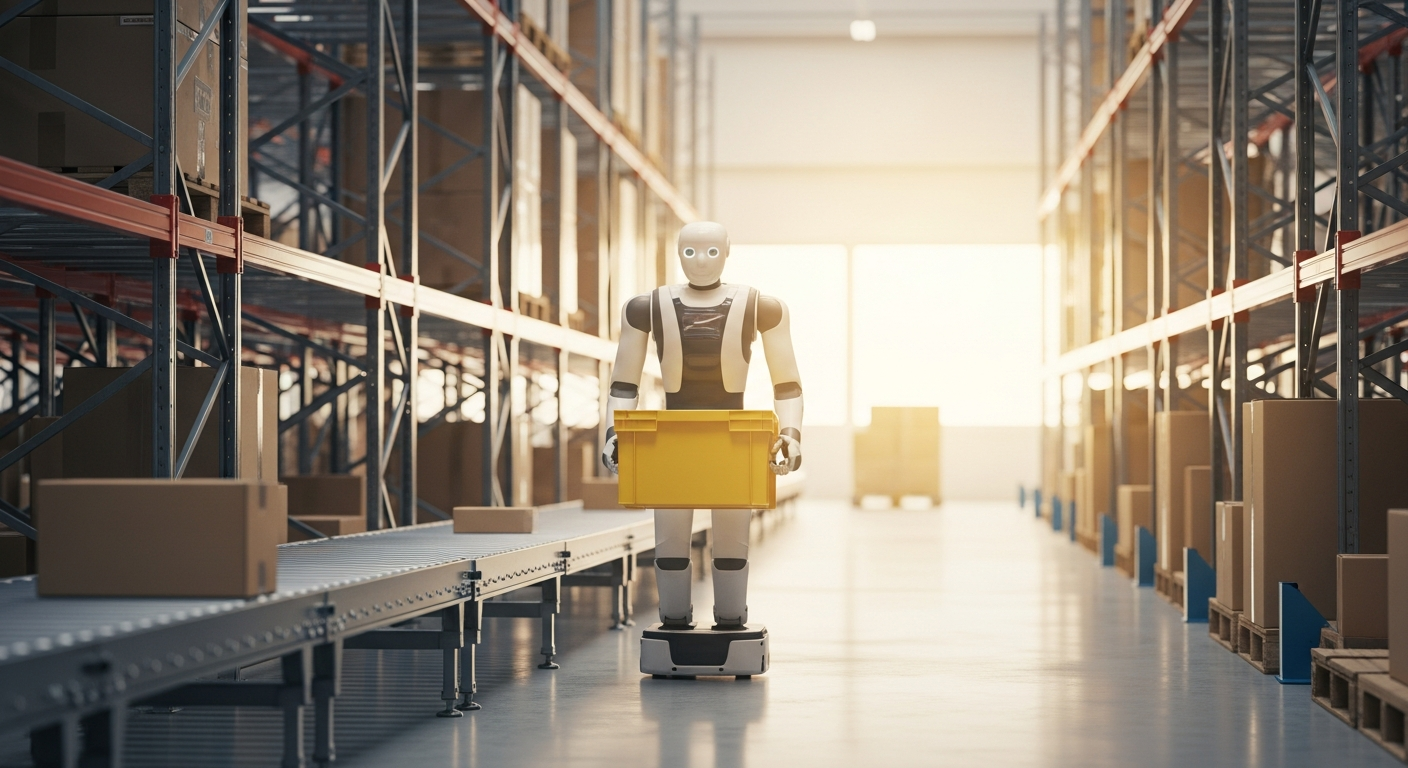
Dispatch #5: Robots on the Factory Floor
Big money is betting humanoids will work factory shifts. We unpack the Apptronik raise, Foxconn's Houston plant, and the reshoring math behind it all.
Welcome back to The Robotics Dispatch, the every-fourth-week column where we step away from the soldering iron and look at what’s actually happening out in the world of real robots. This week the theme is work: robots that move boxes, carry totes, and stand on assembly lines — and the money and labor questions that come with them.
If you’re new here, don’t worry about jargon. We’ll explain the unfamiliar terms as we go, and tie each story back to things you’ve already built or read about.
The lead: a near-billion-dollar bet on factory humanoids
On 11 February 2026, the Austin-based robotics company Apptronik announced it had raised $520 million in new funding, at a reported valuation of around $5 billion, according to CNBC. That round is technically an extension of its existing Series A — the “first big” funding round a startup raises — and it pushes Apptronik’s total Series A past $935 million, with overall funding now near $1 billion, per The Robot Report.
The money is notable, but so is who wrote the checks. Existing backers including Google and Mercedes-Benz returned, and new investors include AT&T Ventures, tractor-maker John Deere, and the Qatar Investment Authority, The Robot Report notes. When a carmaker, a farm-equipment giant, and a sovereign wealth fund all put money into the same humanoid, that’s a signal that the interest isn’t just hype from tech investors — it’s coming from companies that actually run factories and fields.
What is Apptronik building? A roughly six-foot-tall humanoid robot called Apollo, designed to do dull, physical jobs alongside people — moving components, sorting, and “kitting” (gathering the parts needed for one assembly into a single bin). CNBC reports Apollo is built to lift up to about 55 pounds and to work very long stretches. Apptronik says it will use the cash to ramp up production and expand pilot deployments with partners that already include Mercedes-Benz, logistics firm GXO, and manufacturer Jabil, and to keep developing the robot’s “brain” with Google DeepMind, per The Robot Report.
A quick note on what these robots can and can’t do yet. A pilot is a small, limited trial — a handful of robots, one task, one building — not a full rollout. Most humanoid deployments today are pilots. That’s an important caveat we’ll come back to.
Supporting story: Foxconn and Nvidia put humanoids in a Houston plant
Apptronik isn’t alone. Foxconn — the giant contract manufacturer best known for assembling iPhones — is preparing to deploy humanoid robots on the production line at its Houston, Texas factory that builds AI servers for Nvidia, with deployment targeted for the first quarter of 2026, according to Assembly Magazine and reporting picked up by Reuters.
The robots are slated to run on Nvidia’s Isaac GR00T robot-AI software. Just as interesting for us, Foxconn and Nvidia say they planned the whole plant using a digital twin first — a detailed virtual copy of the factory that you can test and rearrange in software before pouring concrete or bolting anything down. (More on why that matters in a moment.)
This is part of a broader pattern called reshoring: bringing manufacturing back to the country where the products are sold, rather than making everything overseas. The catch is that the United States doesn’t have enough workers lining up for factory jobs. The International Federation of Robotics reports U.S. industrial-robot installations rose about 11% in 2025, to roughly 38,000 units — a sign that automation is increasingly how companies plan to fill that gap.
Supporting story: the warehouse numbers behind the trend
The biggest real-world example of robots-at-work isn’t a humanoid at all — it’s Amazon’s warehouses, full of wheeled robots that drive shelves to human pickers. Amazon says it now operates more than one million robots across its fulfillment network (a milestone it crossed in mid-2025) alongside roughly 1.5 million human employees, and that around 75% of customer orders are now handled with some robotic help, per Amazon’s own announcement. A new AI coordinator it calls DeepFleet is meant to route that swarm more efficiently, cutting robot travel time by about 10%.
The economics here are where it gets sensitive. At its highly automated Shreveport, Louisiana site, Amazon uses about a thousand robots and, CNBC reports, expects to eventually staff such facilities with roughly half the workers it would otherwise need — while arguing that automation also creates higher-skill maintenance and engineering jobs. Amazon plans to copy the Shreveport design across about 40 facilities by the end of 2027. Labor advocates read the same numbers and see fewer entry-level jobs; that tension is real and unresolved, and worth holding in mind rather than waving away.
How a robot actually reaches the floor
Here’s the part that ties directly to your recent tutorials. Companies almost never wheel a robot straight onto a live production line. The path looks more like a funnel — simulate, then run a small pilot cell, then (maybe) commit to a full line.
That first box should look familiar. Two weeks ago we simulated a robot before building it, running it in Gazebo so we could find bugs without breaking hardware. A factory’s digital twin is the same idea at industrial scale — which is exactly what Foxconn and Nvidia did before installing a single humanoid.
The middle and final boxes lean on two more things you’ve studied. Real production lines are full of custom grippers, jigs, and fixtures — the little hands and holders that let a generic robot grab one specific part. When we covered 3D printing, we printed flexible TPU grippers and one-off brackets for pennies; manufacturers do the same to adapt a $50,000 robot to a part it was never designed to hold, and they iterate on those prints fast.
And then there’s the unglamorous limit nobody puts in the press release: uptime. A humanoid is only useful while it’s powered. In our power systems tutorial we did the runtime math — capacity in milliamp-hours divided by current draw — and watched a small robot run for barely an hour. Scale that up and you see why a robot’s battery, and how quickly it can recharge or swap packs, quietly decides how many hours of a shift it can actually cover. A robot that needs an hour on the charger for every two hours of work is a very different business case than one that runs a full shift.
Threading the series
Last time, in Dispatch #4 on autonomy and the sensor debate, we looked at how much sensing a robot needs to move safely on its own. Factories sharpen that question: a warehouse or assembly line is a far more controlled, predictable space than a public road, which is one big reason these are among the first places autonomous robots are being trusted to work. Constrain the environment, and the perception problem gets a lot easier.
Next week we head back to the workbench for a tutorial on servo motors — the precise, position-controlled actuators that make a gripper close on exactly the right spot. After a Dispatch about robots doing physical work, it’s a fitting place to return to the parts that do the moving.
The takeaway
Our read: The February funding numbers are real and the corporate interest is genuinely broad, but it’s worth separating the money from the milestones. Almost everything shipping today is a pilot — a few robots, one task — and the honest hard part is the jump from a promising pilot to a profitable full line, where mundane limits like battery uptime, custom tooling, and reliability still bite. We’d watch deployment counts and hours-on-shift far more closely than valuations, and we’d take the labor concerns seriously rather than treating “automation creates new jobs” as a settled fact. The factory floor is changing — just more slowly, and more unevenly, than a billion-dollar round might suggest.
Sources
- Apptronik raises $520 million at $5 billion valuation for Apollo robot — CNBC
- Apptronik brings in another $520M to ramp up Apollo production — The Robot Report
- Foxconn to deploy humanoid robots on production line at Houston AI server plant — Assembly Magazine
- Foxconn to deploy humanoid robots at Houston plant making Nvidia AI servers — Reuters (via Yahoo Finance)
- Amazon deploys over 1 million robots and launches new AI foundation model — About Amazon
- Amazon deploys its 1 millionth robot in a sign of more job automation — CNBC
- U.S. Robot Industry Returns to Double Digit Growth — International Federation of Robotics