Dispatch #7: The Race for Robot Hands — and the Data to Train Them
Sanctuary AI's hand reorients a cube it was never taught on, while new manipulation models from Physical Intelligence and Generalist reframe the data bottleneck.
Welcome back to The Robotics Dispatch, our every-fourth-week roundup where we tie real robotics headlines back to the things you have been learning. This week the spotlight lands on the hardest part of the robot body — the hand — and on the unglamorous fuel that makes a hand useful: data.
For all the progress in robots that walk and roll, getting a robot to reliably pick something up and do something with it remains stubbornly difficult. Two terms you will see throughout: manipulation is the catch-all for a robot using an end-effector (a hand or gripper) to interact with objects, and dexterity is how finely it can control that interaction — the difference between clamping a brick and turning a key. Late April brought a cluster of news that gets at both, and at the question underneath them: where does the training data come from?
The big one: a robot hand reorients a cube it was never taught on
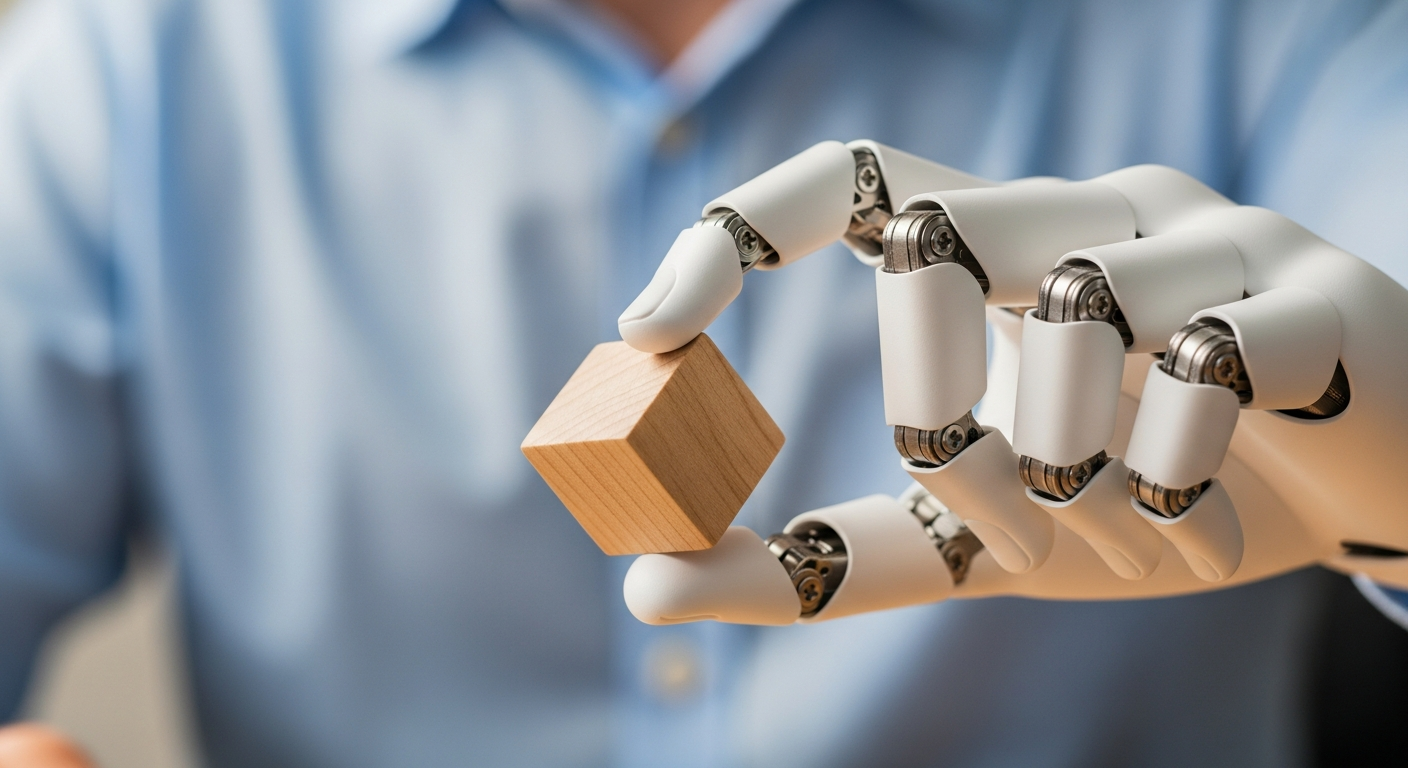
The clearest single result came from Sanctuary AI, the Vancouver company behind the Phoenix humanoid. On April 2, it showed its 21-degree-of-freedom hydraulic robotic hand performing in-hand manipulation — holding a lettered cube at the fingertips and continuously reorienting it to match a target orientation, then hitting that target 10 times in a row without dropping it (The Robot Report).
A few definitions, since this demo leans on them. A degree of freedom (DoF) is one independent way a joint can move; a human hand has around 27, so 21 puts this hand in genuinely hand-like territory. In-hand manipulation means moving an object within the grasp — repositioning some fingers while others keep the object stable — rather than just opening and closing. And the headline claim was zero-shot transfer: the control policy was trained entirely in simulation (a physics model of the hand on a computer) and then run on the real hardware with no additional real-world practice (The Robot Report). “Zero-shot” is borrowed from machine learning and means succeeding on something with no examples of that exact thing beforehand.
Sanctuary framed the result as a building block, saying it lays “the foundation for precise insertion, tool use, and other real-world dexterous tasks” (The Robot Report). It is one demonstration, in controlled conditions, with a single object — worth keeping in proportion. But it is a clean illustration of an idea you have met before: train where data is cheap and infinite, then transfer to the messy real world.
The data fight: bigger brains, and the hunt for demonstrations
A capable hand is only half the problem. The other half is the policy — the trained model that decides what the fingers should do — and policies are hungry for examples. Two announcements in the same window were really about that hunger.
On April 16, Physical Intelligence released π0.7 (pronounced “pi zero-point-seven”), a single model meant to drive dexterous manipulation across different robots without task-specific retraining (Physical Intelligence; TechCrunch). Its calling card is compositional generalization — the ability to remix skills it already has to tackle a task it has never seen. The company describes coaching a robot through operating an air fryer it had encountered in only two training episodes, by combining those fragments with general web knowledge (TechCrunch). The training mix is the interesting part for us: human teleoperated demonstrations, web-scale image-and-text pretraining, and the robots’ own autonomous attempts, pooled across multiple robot types (Physical Intelligence). One figure stuck with us — on a laundry-folding task, human teleoperators with 375 hours of practice only matched the model’s success rate (Physical Intelligence). That is a vivid measure of how much human effort sits behind “autonomous.” Physical Intelligence has raised over $1 billion and was valued around $5.6 billion, with reports of a new round that could push it toward $11 billion (TechCrunch) — treat the higher number as unconfirmed.
A second startup, Generalist, came at the data problem from the opposite end. Its GEN-1 model reportedly lifts average success on a set of physical tasks to 99%, up from 64% for prior approaches, runs roughly 3x faster, and needs only about one hour of robot data per task (Generalist; The Robot Report). The trick: the base model is trained not on expensive robot teleoperation but on roughly half a million hours of video from low-cost wearable devices on people doing everyday activities (Generalist). These are the company’s own benchmarks, not independent ones, so read the percentages as claims rather than settled facts. The strategic bet, though, is clear and worth understanding: if you can learn most of “how hands move” from cheap human video, you need far less of the slow, costly robot data.
A small table to keep the hardware vocabulary straight, since “gripper” covers a lot of ground:
| Gripper type | How it works | Dexterity | Typical use |
|---|---|---|---|
| Parallel-jaw | Two fingers open and close | Low | Pick-and-place, factory lines |
| Suction | Vacuum cup grabs a flat face | Low | Boxes, sheets, smooth parts |
| Soft / underactuated | Compliant fingers wrap around shapes | Medium | Fragile or odd-shaped objects |
| Multi-finger dexterous | Many jointed fingers, often with touch sensing | High | In-hand manipulation, tool use |
The Sanctuary hand sits in that bottom row — the most capable and, not coincidentally, the hardest to control.
Connecting the dots
If you have followed the last three tutorials, you already hold the concepts these stories are built on.
Robot arm kinematics is the math under every grasp. Inverse kinematics — working out the joint angles needed to put an end-effector at a target pose — is exactly what a manipulation policy has to solve, over and over, for each finger. The difference is that a hand-coded arm computes those angles from equations, while a learned policy like π0.7 absorbs the same skill implicitly from thousands of examples. Same problem, two routes to the answer.
SLAM matters because you cannot grasp what you cannot locate. Simultaneous Localization and Mapping is how a robot figures out where it is and where things are around it. Before a hand reorients a cube, perception has to pin down where that cube is in space — the spatial awareness SLAM provides is the unglamorous prerequisite that makes the flashy finger work possible.
Wireless communication is the quiet backbone of this entire data economy. Teleoperation — a human remotely puppeteering a robot, often with VR controllers or a sensored glove — is how most manipulation demonstrations get recorded, and that only works over a low-latency link. The radio links you studied are what carry an operator’s hand motions to the robot and stream the robot’s camera and sensor data back, frame by frame, so the loop in our figure can even close.
This also threads straight out of Dispatch #6 on robots leaving the lab. Robots earn their keep in the real world mostly by doing things with their hands — sorting, assembling, loading — so the manipulation race is the same story viewed up close. Getting out of the lab and getting a grip on the world are two sides of one coin.
Next week we step back into the tutorials and pick up a tool that sits right at the front of every grasp: computer vision with OpenCV — how to make a robot actually see the object before it reaches for it.
The takeaway
To keep this balanced: even the people building these systems are candid that dexterity is far from solved. Physical Intelligence’s co-founder Sergey Levine has noted you still cannot simply tell a robot “go make me some toast,” and that success can swing wildly with how a task is phrased — one task reportedly jumped from 5% to 95% after the instructions were rewritten (TechCrunch). And because standardized manipulation benchmarks barely exist yet, most of the eye-catching numbers above are self-reported demos, not independently verified results.
Our read: the most telling thread this week was not any single hand — it was that two of the three big stories were really about data. When a model needs only an hour of robot data because it learned the rest from cheap human video, or when 375 hours of human teleoperation is the yardstick a “zero-shot” model has to beat, the message is the same: the hardware is racing ahead, and the demonstrations to train it are the real bottleneck. We would watch the data-collection efforts — gloves, wearables, teleop rigs — as closely as the hands themselves. Whoever solves cheap, diverse manipulation data may quietly decide who wins.
Sources
- Sanctuary AI’s robotic hand demonstrates zero-shot in-hand manipulation — The Robot Report
- Top 10 robotics stories of April 2026 — The Robot Report
- π0.7: a Steerable Generalist Robotic Foundation Model — Physical Intelligence
- Physical Intelligence says its new robot brain can figure out tasks it was never taught — TechCrunch
- GEN-1: Scaling Embodied Foundation Models to Mastery — Generalist
- Generalist introduces GEN-1 general-purpose model for physical AI — The Robot Report