
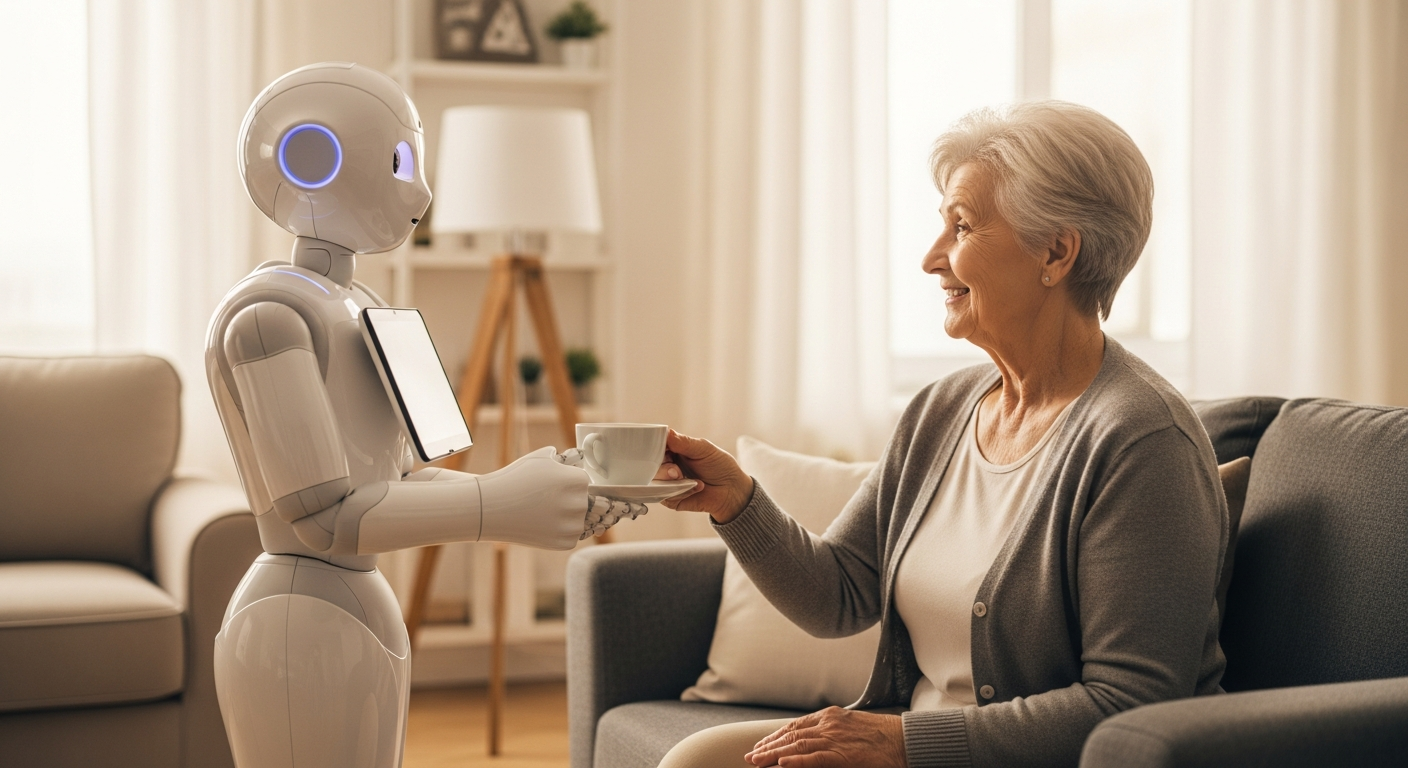
Dispatch #8: The Rulebook Catches Up — Safety, Standards, and a Mid-Year Reality Check
New robot-safety standards, a whistleblower lawsuit over 'skull-fracturing' force, and a sober look at how many humanoids are actually deployed in 2026.
Welcome back to The Robotics Dispatch, our every-fourth-week roundup that ties real robotics headlines back to the things you have been learning. Over this series we have followed the money (Dispatch #1), the AI models (#2), the show floor at CES (#3), self-driving autonomy (#4), factory robots (#5), real-world deployments (#6), and most recently the race for robot hands (#7). This week the theme is the least flashy and arguably the most important: rules and safety — the standards, lawsuits, and sober assessments deciding whether all that hardware is actually fit to stand next to a human. It is also the halfway point of the year, so we will end with a reality check on hype versus deployment.
The big one: domestic-robot safety standards are being rewritten
The clearest in-window story comes from IEEE Spectrum, which reported on May 19 that the international safety standard for home and care robots is being overhauled — and that the people writing it are openly worried it is not enough (IEEE Spectrum).
A quick definition first, because this Dispatch leans on it. A standard is an agreed-upon rulebook, written by a neutral body, that says how a product must be built or tested to count as “safe.” The big one here is published by ISO (the International Organization for Standardization, a global standards group based in Geneva). The relevant document, ISO 13482, covers “personal care robots” — robots meant to operate around ordinary people in homes — and it is roughly twelve years old, written before today’s walking humanoids existed (IEEE Spectrum).
The catch, according to Jae-Seong Lee, a technology-policy researcher at South Korea’s Electronics and Telecommunications Research Institute quoted in the piece, is that the revision identifies hazards but still lacks “binding compliance criteria, test methods, or enforcement mechanisms” for the messiness of humans and robots sharing a space (IEEE Spectrum). His framing is worth sitting with: “Safety is not a fixed property of the machine alone; it emerges from the relationship.” In plain terms, you cannot certify a home robot as safe just by testing the machine on a bench — safety depends on the unpredictable person standing next to it.
This connects to a second term you will see everywhere in this space: functional safety. That is the engineering discipline of making sure a system behaves safely even when something fails — a sensor dies, a motor glitches, the software hits a bug. The question these standards are wrestling with is how to prove functional safety for a machine that has to keep its balance to avoid falling on someone.
Why humanoids broke the old rulebook
To understand why this is hard, it helps to know what the industrial standards already cover. Earlier in 2025, the long-standing factory-robot standard ISO 10218 got its first major overhaul in nearly eight years (published February 2025), and the U.S. equivalent, ANSI/A3 R15.06, followed in October 2025 (The Robot Report; ANSI Blog). The update jumped from a handful of defined safety functions to more than thirty, folded in collaborative-robot rules, and even added cybersecurity requirements (ANSI Blog).
But here is the gap. Traditional industrial robots are statically stable — cut the power and the arm just stops, dead and harmless. Humanoids are dynamically stable: they need continuous active control simply to stay upright. As Aaron Prather of ASTM International (a U.S. standards body) put it for an MIT Technology Review piece on this exact problem, you cannot just slam an emergency stop, because the robot “would fall and potentially cause greater harm” (MIT Technology Review). A separate standard, ISO 25785-1, was opened to cover these dynamically stable machines, with fall-zone calculations and battery rules, but it too is aimed at industrial use, not your living room (IEEE Spectrum).
A lawsuit that put numbers on the risk
The abstract debate about force limits got a very concrete, if contested, illustration late last year — and it is still working its way through the courts. In November 2025, Rob Gruendel, the former head of product safety at the well-funded U.S. startup Figure AI, sued the company in federal court in California, alleging he was fired in retaliation for raising safety alarms (CNBC; Humanoids Daily).
His complaint alleges the company’s robot could generate force “more than twice” what is needed to fracture an adult skull, and describes an incident in which a robot punched a steel refrigerator door next to an employee, leaving a quarter-inch gash (CNBC). It is important to be fair here: these are allegations in a wrongful-termination suit, not proven facts. Figure has flatly denied them, saying Gruendel was “terminated for poor performance” and that his “allegations are falsehoods that Figure will thoroughly discredit in court” (CNBC). We are reporting the dispute, not endorsing either side. But it explains, vividly, why standards bodies are so focused on quantifying impact force — and why this story keeps echoing through the safety conversation.
On the policy side, lawmakers are circling too, though slowly. Earlier in 2026, U.S. senators introduced the bipartisan “Humanoid ROBOT Act” (S. 3275), which would bar federal agencies from buying AI-equipped humanoids made by companies tied to China, Russia, Iran, or North Korea, and a separate bill proposed a National Commission on Robotics to study competitiveness and safety (The Robot Report). Note what these do not do: neither sets a binding home-safety rule for the robots themselves. The rulebook for the machine in your living room is, as one outlet put it, still mostly blank.
Connecting the dots
If you have followed the last three tutorials, you already hold the pieces that make robot safety make sense.
Computer vision with OpenCV is where safety actually begins. A robot can only avoid a person it correctly sees. When we covered detection and its failure modes — odd lighting, motion blur, an object the model has never encountered — that was not just an accuracy problem. A robot that mis-sees a child as empty floor is a robot that may move into that space. That is exactly the “sensing” layer in the figure above, and it is the first thing any force-limiting safety system has to get right.
TF2 coordinate frames are the quiet foundation of safe motion. Recall that TF2 keeps track of where everything is relative to everything else — the gripper relative to the base, the base relative to the room. If those transforms are wrong by even a few centimeters, the robot’s idea of “stop 30 cm from the human” is wrong by the same amount. Getting the geometry right is not a tidiness exercise; it is the difference between a safe stand-off distance and a collision.
Chassis design brings it back to the physical body. We talked about mass placement and stability — and that is the whole ballgame for a humanoid. A machine that must actively balance is one bad step from falling, and where its mass sits determines how hard it lands. The new standards’ obsession with “fall zones” and dynamic stability is really just our chassis lesson, raised to the stakes of a 60-kilogram machine standing beside a person.
Together they map onto the safety layers: chassis decides how the body fails, vision and TF2 decide whether the robot perceives and locates people in time, and the software supervisor decides what to do when a fault hits.
The mid-year reality check
Halfway through 2026, it is worth asking the blunt question: how many humanoids are actually doing real work? The honest answer, across multiple sober assessments, is fewer than the hype implies — but more than zero, and rising.
| Where humanoids are in mid-2026 | Snapshot |
|---|---|
| Industrial pilots (West) | Real but small — BMW, Mercedes, Hyundai measured in dozens of units (Winss) |
| Production at volume | Largely China-led; Unitree reportedly past ~5,500 units shipped (Winss) |
| Committed deployments | Boston Dynamics says it has orders on the order of 25,000 Atlas robots (The Robot Report) |
| Tesla Optimus | ~1,000 units reported on Fremont floors, used for learning, not production; mass build pushed to mid-2026 (Electrek) |
The pattern is consistent with what a Robotics Summit panel of people who actually build these machines described in 2026: genuine momentum and real orders, but “the reality is more nuanced,” with most deployments still in pilot or industrial-testing phases and costs above consumer levels (The Robot Report). Treat the unit counts above as ballpark — they vary by source and shift monthly — but the shape is clear: shipping has started, scale has not arrived, and the safety rulebook is racing to keep up with both.
Next week we step away from the news and get practical with debugging hardware — fittingly, what to do when things go wrong. After a Dispatch about failure modes and safety, learning to diagnose your own gremlins feels like exactly the right next move.
The takeaway
To weigh both sides fairly: the optimists are right that 2026 is a real inflection — orders are being placed, factories are running pilots, and the standards machinery (ISO 10218, R15.06, ISO 25785-1, the ISO 13482 revision) is finally moving after years of inertia (The Robot Report). The skeptics are right that the rules for dynamically stable robots remain unfinished, that home deployment has essentially no binding safety standard yet, and that at least one safety lead has gone to court alleging the “move fast” culture outran the guardrails (IEEE Spectrum; CNBC).
Our read: standards usually trail technology, and that is the normal, healthy order of things — but the gap right now feels uncomfortably wide for machines designed to physically share our space. We would rather see this year remembered for the boring, careful work of writing testable force limits and fall-zone rules than for the demo reels. The most encouraging sign is not a flashier robot; it is that the safety conversation is finally as loud as the funding one. Watch the standards bodies, not just the launch events — they will tell you when humanoids are genuinely ready to come home.
Sources
- Domestic Humanoid Robot Safety Standards Are Shifting — IEEE Spectrum
- ISO 10218 industrial robot safety standard receives major overhaul — The Robot Report
- What Is ANSI/A3 R15.06-2025? — The ANSI Blog
- Why humanoid robots need their own safety rules — MIT Technology Review
- Figure AI sued by whistleblower who warned robots could ‘fracture a human skull’ — CNBC
- Ex-safety head sues Figure AI over ‘skull-fracturing’ robot risks — Humanoids Daily
- Bills introduced to strengthen U.S. robotics competitiveness, humanoid security — The Robot Report
- Robotics Summit panel explores the state of humanoid robot design — The Robot Report
- Innovative Humanoid Robots in 2025–2026 — Reality or Hype? — Winss Solutions
- Tesla pushes Optimus V3 reveal later this year — again — Electrek