
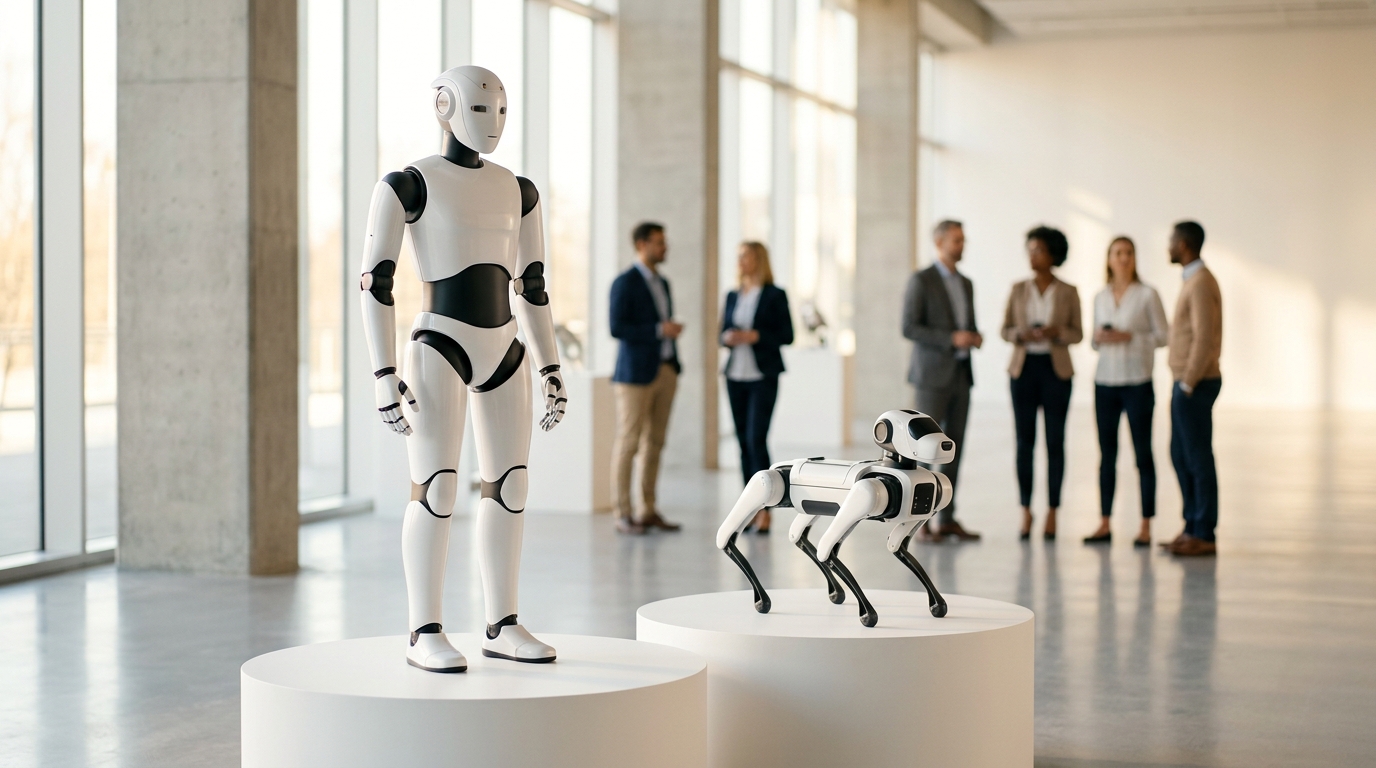
Dispatch #11: Unitree's $9 Billion IPO, and Beijing's World Robot Conference
Unitree Robotics becomes the first humanoid robot maker listed on a mainland China exchange, popping 460% on debut day — timed to open right alongside the World Robot Conference and its 2,000-robot Games in Beijing.
Welcome back to The Robotics Dispatch. Last time (#10), the story was ownership: Hyundai finishing its buyout of Boston Dynamics, and a new European humanoid unicorn betting on wheels over legs. This fortnight, the story is public markets — a humanoid robot maker went public on a Chinese exchange for the first time, and its debut landed the same week as the industry’s biggest annual trade show, in the same city.
The lead: Unitree goes public, and the market goes wild
On August 19, shares of Hangzhou-based Unitree Robotics began trading on Shanghai’s STAR Market — a tech-focused board similar in spirit to Nasdaq — after pricing its IPO on August 6 at 150.8 yuan per share (Bloomberg). The offering raised 6.1 billion yuan (about $904 million) by selling roughly 40.45 million shares, around 10% of the company’s enlarged share count, and it made Unitree the first humanoid robot manufacturer listed on a mainland China exchange (South China Morning Post).
The stock didn’t just rise — it spiked, and by how much depends slightly on which moment you measure. The South China Morning Post reported shares opened as much as 629% above the IPO price, hitting 1,100 yuan intraday, before easing back; multiple outlets agree the stock settled to close the day up 460%, at 845 yuan (South China Morning Post; CNBC). That closing price valued Unitree at roughly 342 billion yuan (about $66 billion) — comfortably ahead of the pre-IPO valuation of 61 billion yuan, and ahead of other recently listed Chinese tech names on the same exchange. Founder Wang Xingxing, 36, holds about 121.4 million shares worth roughly 103 billion yuan at that closing price; e-commerce and delivery giant Meituan, an early backer, held an 8.7% stake worth nearly 30 billion yuan — reportedly about 70 times what it originally put in (South China Morning Post). Chinese AI lab DeepSeek was also among the investors in the offering, putting in about 140.8 million yuan.
Unitree is best known outside China for viral videos of its dancing and backflipping quadrupeds and, more recently, its G1 and R1 humanoids. But the filing behind this IPO is more grounded: humanoid robots became the company’s largest single revenue segment in 2025, at 867.8 million yuan, alongside its long-running quadruped business (RobotToday). A 460% first-day pop is a euphoria story as much as a company story — but it’s also the clearest sign yet that public investors, not just venture funds, now want direct exposure to humanoid robotics.
Beijing’s World Robot Conference opens the same week
Unitree’s timing wasn’t a coincidence. Its debut landed just as the 2026 World Robot Conference opened in Beijing, running August 19–23 under the theme “Human-Robot Symbiosis, Production-Demand Convergence.” This year’s edition grew sharply: more than 300 exhibitors (up 36% year over year) showed over 2,000 products across roughly 50,000 square meters of floor space, with close to 150 new-product debuts and nearly 30% international attendance (RobotToday). For the first time, organizers added a dedicated pavilion for state-owned enterprises, where 49 central SOEs presented robotics use cases spanning energy, aerospace, manufacturing, logistics, and emergency response — a sign that in China, robot deployment is treated as state industrial policy, not just startup ambition (CGTN).
The conference’s public-facing centerpiece was the Second World Humanoid Robot Games, opening August 22 at Beijing’s National Speed Skating Hall — the same venue used for the 2022 Winter Olympics. Organizers reported 666 teams from 16 countries entering 2,056 robots across 51 events over five days, from track-and-field-style races to industrial skills challenges (RobotToday). It’s a spectacle first and a benchmark second, but also the largest public side-by-side comparison of humanoid mobility and dexterity anywhere this year.
Also this fortnight: on August 11, drone maker Neros Technologies closed a $250 million Series C at a $2.5 billion valuation, co-led by Sequoia Capital and the American Strategic Technology Fund (PR Newswire). The round funds Neros’s FPV strike drone and a new counter-drone interceptor, with the company aiming to build a million drones a year by 2028 under contracts with the U.S. Army, Marine Corps, and SOCOM. It’s a reminder that 2026’s robotics funding boom isn’t only humanoids — autonomous aircraft are raising at similar multiples, for a very different customer.
Connecting the dots
A public listing and a robot expo both look, from the outside, like business and spectacle. But the robots on that Beijing show floor, and the humanoid Unitree just took public, depend on exactly the perception stack this site has spent the last three weeks building. Point clouds are how a humanoid figures out what’s actually in front of it in 3D — not just “something is 40 centimeters away,” which a single 2D scan can tell you, but the actual shape of a step, a tray, or a teammate robot on a crowded floor. Every one of the 2,056 robots at the Humanoid Games needed that kind of 3D read on its surroundings to avoid faceplanting into an obstacle course, live, in front of a crowd.
That 3D read is only as good as the camera producing it, which is where camera calibration comes in. The intrinsic matrix you’d solve for with a checkerboard pattern at home is the same math a company like Unitree runs at manufacturing scale on every G1 or R1 that ships — an uncalibrated camera doesn’t know its own geometry, and a robot that doesn’t know its own geometry can’t safely reach for a part or step onto a curb.
And underneath both is sensor fusion with an EKF — the same predict/correct cycle you set up with robot_localization to blend a drifting IMU with drifting wheel odometry. Neros’s Archer AI drone advertises a “GPS-denied Position Hold” mode, the same problem in the air: no wheel encoders, but an IMU and other onboard sensors still need fusing into one pose estimate the moment satellite navigation drops out. A backflipping quadruped on a Beijing stage and a $2.5-billion interceptor drone are solving the same estimation problem you did in Week 33, just with different sensors and much higher stakes.
Next week we finish the perception block with Depth Cameras in Practice, covering RealSense and OAK cameras — the actual hardware that turns the point-cloud and calibration theory of the last two weeks into a sensor you can bolt onto a robot today.
The takeaway
A 460% first-day pop says more about scarce public-market supply of “pure robotics” stocks than about Unitree’s underlying business — IPO-day euphoria in a thin market isn’t the same thing as sustainable revenue growth. Our read: the more durable story this fortnight is the mix, not the multiple. A dancing-robot company’s biggest revenue line is now humanoids sold into real, if early, commercial use; a state-organized conference is treating robot deployment as industrial policy; and a drone maker is raising at humanoid-scale valuations for a very different application. Robotics investment in 2026 is broadening out — across form factors, borders, and now public and private markets at once — faster than any one stock chart can tell you.
Sources
- Unitree Robotics Set to Debut After $904 Million Shanghai IPO — Bloomberg (August 18, 2026)
- Unitree Robotics surges 629% to US$66 billion valuation in Shanghai share debut — South China Morning Post (August 19, 2026)
- China’s backflipping robot maker Unitree pops 542% in Shanghai debut — CNBC (August 19, 2026)
- World Robot Conference 2026 Opens in Beijing Aug. 19–23, Days After Unitree’s $9B IPO — RobotToday
- World Robot Conference: What can humanoid robots actually do? — CGTN (August 22, 2026)
- 2026 World Humanoid Robot Games Kick Off in Beijing with 666 Competing Teams — RobotToday
- Neros Raises $250M Series C at $2.5B Valuation to Scale Autonomous and Interceptor Drone Programs — PR Newswire (August 11, 2026)