
Dispatch #1: A Home Humanoid Goes on Sale, and the Money Behind It
Our first news roundup: 1X opens orders for a $20,000 home humanoid as record money pours into general-purpose robots — and why the timing isn't a coincidence.
Welcome to The Robotics Dispatch — a new thing we’re trying here at Weekly Robotics. Most weeks you’ll get a hands-on tutorial, but every fourth week we’ll step back from the breadboard and look at what’s actually happening out in the robotics world. The mission is simple: take the headlines you’re seeing everywhere right now and tie them back to the fundamentals you’re learning on this site, so the news stops feeling like hype and starts feeling like something you understand. This is the very first one, so let’s get into it.
The theme this month is hard to miss: an enormous amount of money is flowing into humanoid robots (robots shaped roughly like a person — two arms, two legs, a head) and the AI that runs them. Let’s start with the story that made it concrete for ordinary people.
The lead: a home humanoid you can actually order
On 28 October 2025, the Norwegian-American company 1X opened orders for NEO, which it bills as a humanoid robot for your house. You can read the announcement coverage at The Robot Report. The pricing is the eye-catching part: $20,000 as a one-time purchase, or $499 per month as a subscription, with a refundable $200 deposit to hold your place. Deliveries are slated to begin in 2026, starting in the United States (1X’s order page).
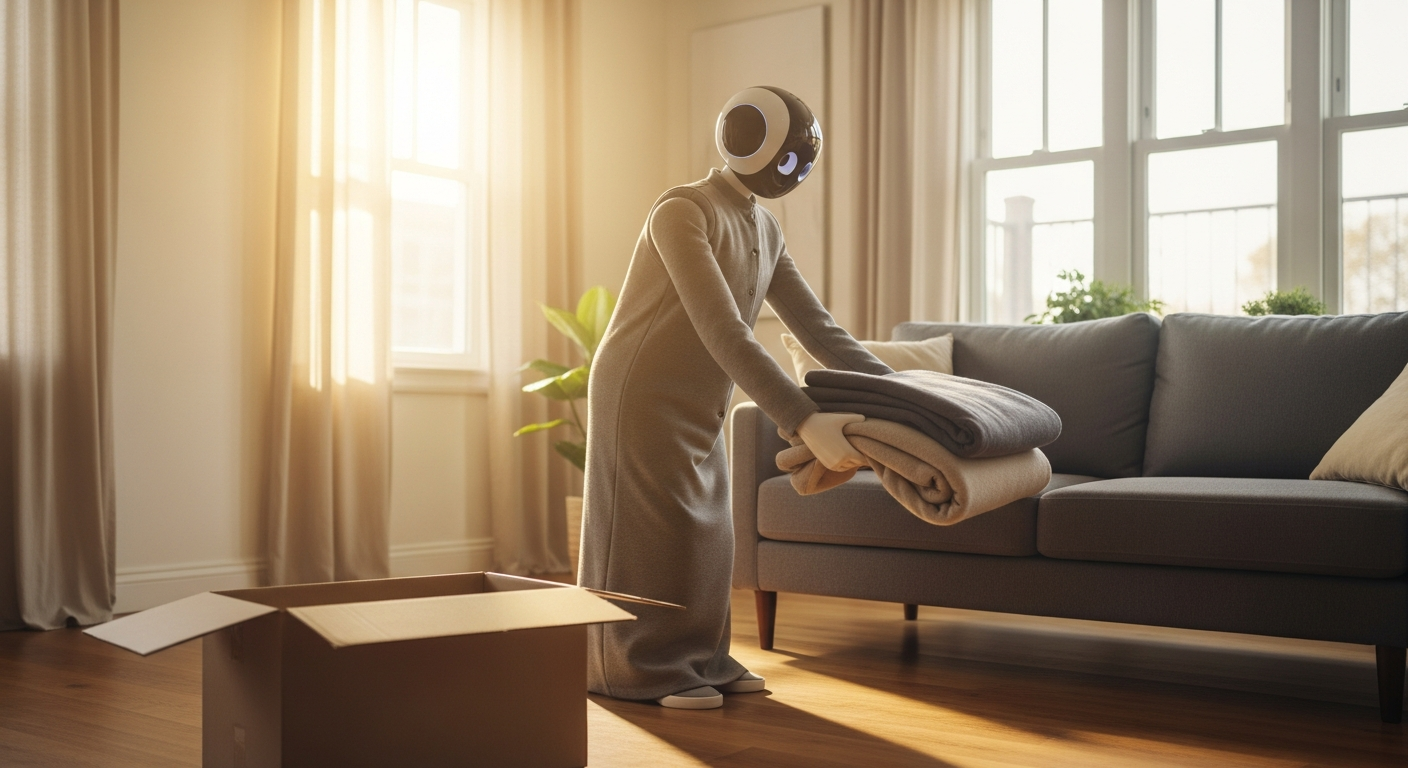
NEO weighs about 66 pounds (30 kg), and 1X says it can lift well over 100 pounds. The pitch is a household helper that folds laundry, tidies up, fetches things, and opens the door for guests. “Humanoids were long a thing of sci-fi,” said 1X founder and CEO Bernt Børnich. “Then they were a thing of research, but today — with the launch of NEO — humanoid robots become a product” (The Robot Report).
Here’s the important fine print, and it’s where a beginner’s instincts serve you well. NEO is not fully autonomous yet. For tasks it hasn’t learned, 1X says an owner can schedule a remote human teleoperator to pilot the robot through the job — a real person, watching through the robot’s cameras, guiding its hands (The Robot Report). 1X says it addresses the obvious privacy questions with “no-go” zones and face-blurring. As outlets like Robotics 24/7 noted in covering the launch details, that points to a real tension: a robot that sometimes needs a remote operator driving it is a different product from one that just does the work on its own. Keep that distinction in your back pocket — it comes up again below.
Why now? Two curves crossing
A reasonable question is: why is this the moment? Robots aren’t new. The honest answer is that two trends finally crossed.
The first is AI. The same machine-learning advances behind chatbots are now being aimed at controlling bodies — turning a camera feed and a goal (“pick up that cup”) into the right sequence of movements. The second is hardware getting cheaper and better, especially the parts that make a robot move. And that’s where this connects directly to what you’ve been learning.
If you read The Brains of the Operation, you know the difference between a microcontroller (a small, cheap chip that handles one real-time job, like reading a sensor or driving a motor) and a microprocessor (a more powerful brain that runs an operating system and does heavy thinking). A humanoid uses both, layered: beefy processors and AI accelerators for the “what should I do” decisions, and dozens of humble microcontrollers near each joint handling the “spin this motor, right now, precisely” part. The expensive AI brain got the headlines; the cheap, fast little brains are what make the body practical.
And every one of those joints? It’s the idea from last week’s tutorial, scaled up. In Making Things Move you built the intuition that a motor can’t connect straight to a control chip — it needs a motor driver, typically an H-bridge (four electronic switches that send current through the motor in either direction) controlled by PWM (pulse-width modulation — switching power on and off very fast to control speed). A humanoid’s elbow, knee, and finger are the same motor-plus-driver pattern, just dozens of times over, built to industrial tolerances. When those drivers and motors get cheaper and more capable, a robot with 30-plus joints suddenly costs thousands instead of hundreds of thousands. That cost curve is a big part of “why now” — and it’s the exact circuit you can build on a desk for a few dollars.
(If you’re brand new and none of those terms ring a bell, the series opener explains how this whole tutorial track fits together.)
The money behind the moment
NEO is one product, but it’s riding a much larger wave of investment. A few anchor points from 2025, all verifiable:
| Company | Round (2025) | Notable backers |
|---|---|---|
| Figure AI | $1B+ Series C, ~$39B valuation (Sept) | Parkway VC, NVIDIA, Intel Capital, Qualcomm |
| Apptronik | $350M Series A, grew to ~$403M (Feb) | Google, Mercedes-Benz, B Capital |
| 1X | NEO orders open (Oct) | — |
A “valuation,” by the way, is roughly what investors think the whole company is worth, based on the price they pay for a slice of it — it is an estimate of future promise, not money in the bank or profit earned.
Two details are worth noticing. First, the names backing these companies are not just venture funds — they’re industrial giants. Apptronik’s round included Google and Mercedes-Benz, the latter already testing the company’s Apollo robot in its plants (GlobeNewswire). When a carmaker invests in the robots it might put on its own line, that’s a signal beyond pure speculation. Second, this is a banner year for the whole field: by mid-September, robotics startups had already raised more than $8.5 billion in 2025, putting the sector on track for its biggest year since the 2021 peak, according to Crunchbase News.
The figure below sketches that trend.
The other side of the ledger
It would be easy to read all this as “the robots have arrived.” Be a little careful. Funding is a bet on the future, not proof of a finished product — and Crunchbase itself noted that despite the cash, 2025 hasn’t yet produced the big robotics acquisitions or public-market exits that usually mark a maturing industry (Crunchbase News). The NEO teleoperator detail is the clearest reminder: a demo, or even a shipping product, can still lean on a human behind the curtain. Capital is racing ahead of capability, and the gap between an impressive video and a robot that reliably folds your laundry, unsupervised, is still real.
That gap, in part, is an engineering problem about coordination — getting all those joints, sensors, and brains to act as one body. Which is a perfect handoff to next week’s tutorial, Setting Up CAN Bus for Robotics: the communication system that lets the many controllers inside a complex robot (or a car) talk to each other without tripping over one another. Once you’ve seen how that messaging works on two Arduinos, the inside of a humanoid looks a lot less like magic.
The takeaway
Our read: this is a genuine inflection point, not just noise — cheaper actuators and better AI really have lowered the bar, and serious industrial money (Google, Mercedes-Benz, NVIDIA) is harder to dismiss than hype alone. But we’d separate the technology story from the valuation story. The engineering is advancing fast; the prices and valuations are running on optimism about a future that hasn’t shipped. If you’re a beginner, the encouraging part is that the core ideas inside these multi-billion-dollar machines are the same motors, drivers, and controllers you can wire up on a desk this weekend. Watch the products, not the headlines — and notice how often “autonomous” still has an asterisk.
Sources
- The Robot Report — 1X announces pre-order launch of NEO humanoid robot
- 1X — Order NEO
- Robotics 24/7 — 1X announces NEO consumer-ready humanoid robot pre-order details
- Figure AI — Series C announcement ($1B+, $39B valuation)
- GlobeNewswire — Apptronik raises $350 million
- Crunchbase News — Robotics funding crests higher as Figure lands another $1B