Dispatch #2: Robots That See and Learn
A beginner-friendly roundup of late-2025 robotics news — vision-language-action models like π0.6, Gemini Robotics, and Nvidia GR00T move onto real hardware.
Welcome back to The Robotics Dispatch — the column where, every few weeks, we step away from the soldering iron and look at what’s happening in the wider robotics world, then tie those headlines back to the basics you’ve been learning. No prior news-reading required; we explain the jargon as we go.
Last time, in Dispatch #1, the humanoid funding wave, we followed the money — the eye-watering investments pouring into humanoid robot companies. This time we follow the intelligence: the software brains that let those machines see a scene, understand a plain-language instruction, and actually do something about it. It was a big theme of 2025, and the last few weeks gave us some of the clearest examples yet.
The big idea: robots are getting “foundation models”
You’ve probably heard of large language models — the systems behind chatbots that are trained on enormous piles of text. Robotics has been chasing its own version of that, and 2025 was the year the idea got a name in the headlines: the robot foundation model, often built as a VLA, short for vision-language-action model.
Here’s the plain-English version. A VLA is a single large neural network that takes in vision (camera images), reads a language instruction (“fold the towels”), and outputs action (the motor commands that move the robot). One model, three jobs, glued together. That’s a real shift from the older approach, where a team hand-wrote separate programs for perceiving, planning, and moving.
Lead story: Physical Intelligence’s π0.6 learns from its own mistakes
The clearest in-window example came from Physical Intelligence, a San Francisco startup focused entirely on these models. On November 17–18, 2025 the company released a model it calls π*0.6 (said “pi-star-zero-point-six”) alongside a research paper titled “a VLA That Learns From Experience”.
What makes it notable is the “learns from experience” part. Most robot-learning demos are trained by imitation — a human teleoperates the robot through a task many times, and the model copies those demonstrations. π*0.6 adds a step on top: the robot keeps practicing on its own, and the system uses its successes and failures (plus occasional human corrections) to improve. Physical Intelligence calls the recipe RECAP, and reports that “on some of the hardest tasks, RECAP more than doubles task throughput and roughly halves the task failure rate” compared with imitation alone (model card, Nov 17, 2025).
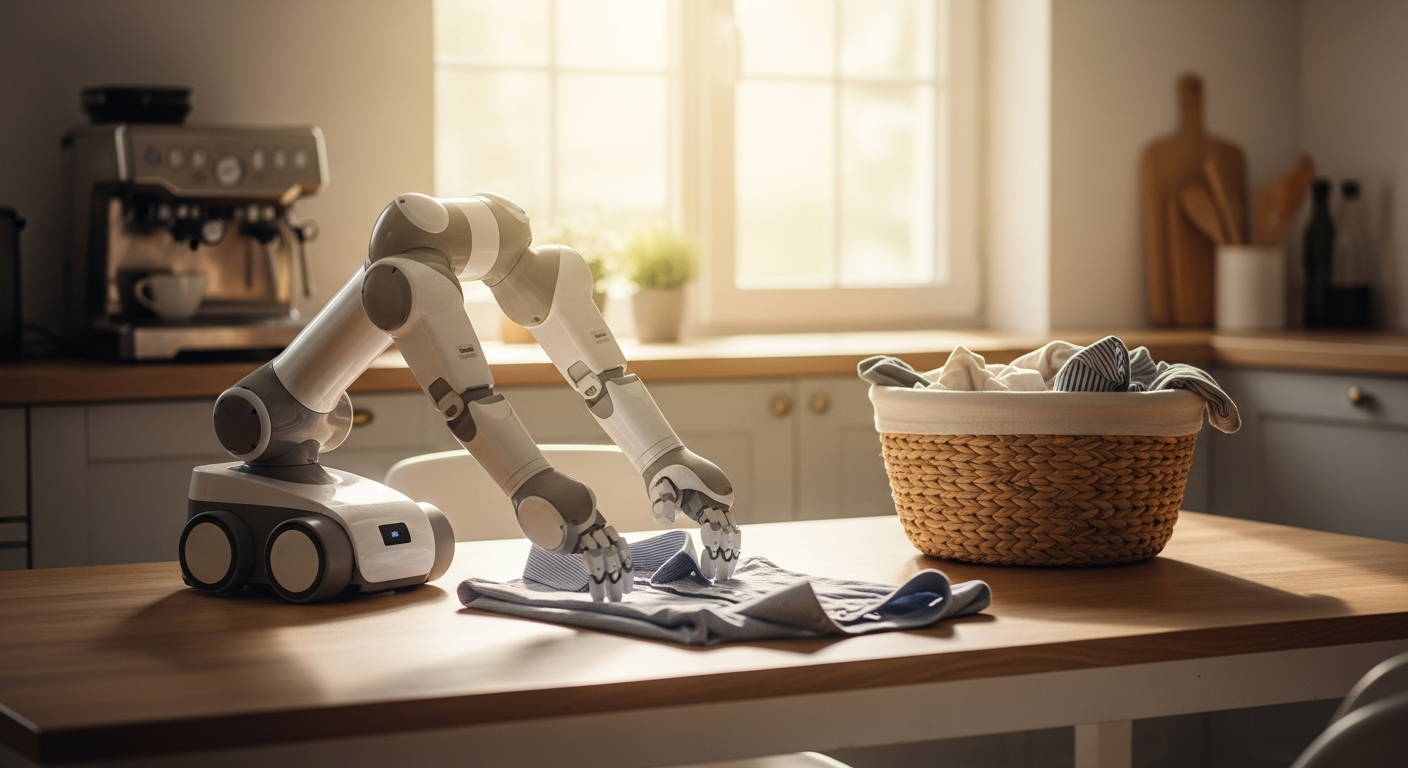
The demos are the kind of everyday chores that are deceptively hard for robots: folding laundry in real homes, assembling cardboard boxes, and pulling espresso shots on a real machine. One widely shared example showed a robot running an office espresso bar for most of a day. Treat the throughput numbers as the company’s own reported figures rather than independent results — but the direction is clear.
Connecting the dots: this is “learning,” but not the kind from week 6
Two tutorials ago, in reinforcement learning frameworks, we met reinforcement learning (RL) — an agent that learns a policy (a strategy for what to do in each situation) by trial and error, guided by a reward signal. Both RL and these big VLAs are ways a robot can “learn,” but they’re not the same thing, and it’s worth keeping them straight:
| Classic RL (week 6) | VLA foundation model | |
|---|---|---|
| Starts from | Scratch, knowing nothing | A large model pretrained on lots of data |
| Main fuel | Reward from trial and error | Human demonstrations and internet-scale data |
| Usual home | A simulator, then “sim-to-real” | Often trained on real robots |
| Understands language? | No | Yes — that’s the “L” |
The interesting twist with π*0.6 is that it blends the two: a pretrained VLA that then keeps improving from real-world experience, which is exactly the trial-and-error idea from week 6 bolted onto a much bigger starting brain.
Supporting story: Google DeepMind teaches robots to “think before acting”
Earlier in the autumn, on September 25, 2025, Google DeepMind introduced Gemini Robotics 1.5, its most capable VLA to date, paired with a second model, Gemini Robotics-ER 1.5 (the “ER” stands for embodied reasoning — reasoning about the physical world). DeepMind frames it as a two-part brain: the ER model acts “like a high-level brain” that plans the steps, and the VLA carries them out.
Two ideas stand out for beginners. First, “thinking before acting”: instead of jumping straight from instruction to motion, the model can “generate an internal sequence of reasoning and analysis in natural language” — roughly, it talks itself through the plan first. Second, learning across embodiments: DeepMind reports that skills taught on one robot during training “also just work” on very different machines, including a humanoid, without retraining from scratch. If that holds up broadly, it chips away at one of robotics’ most expensive problems — re-teaching every new robot from zero.
The year-end backdrop: models moving onto real hardware
Zoom out and a pattern emerges. Back in March, Nvidia announced Isaac GR00T N1, which it billed as “the world’s first open, fully customizable foundation model” for humanoid robots — and crucially, open, so other developers can build on it. It pairs a slow “System 2” planner with a fast “System 1” action model, the same split-brain idea we just saw at DeepMind. Nvidia also leaned hard on synthetic data (computer-generated training examples) from its Cosmos simulation tools, reporting it generated “780,000 synthetic trajectories … in just 11 hours” and that mixing that with real-robot data “improved GR00T N1’s performance by 40%.”
Tie that back to Dispatch #1: the money flowed into humanoid bodies, and through 2025 the field raced to give those bodies general-purpose brains. The throughline of the year, echoed across industry year-in-review coverage, is that VLAs moved from research papers toward working demonstrations on real hardware.
Where week 5’s cameras fit in
None of this works without eyes. Remember the 2D vs 3D cameras tutorial: a plain webcam gives a flat grid of colored pixels, while a depth camera also reports how far away each pixel is. The “vision” feeding every VLA above is exactly that kind of camera data. A model can only fold a towel it can see, and judging how far your gripper is from the fabric is precisely the depth information a 3D camera provides. The fancy brain still rides on top of the humble sensor stack we’ve been building.
Next week we get back to hands-on building with ROS 2 — the middleware that lets a robot’s many programs (camera driver, planner, motor controller, and yes, a model like these) talk to one another. It’s the connective tissue that turns a pile of clever parts into one working robot.
The takeaway
Our read: this is real progress, and also a moment to keep expectations honest. The genuinely new thing in late 2025 isn’t that robots can do a tidy demo — it’s the move toward models that keep learning from real-world experience, like π*0.6, rather than freezing after a fixed training run. That’s a meaningful direction. But notice that the most striking numbers — doubled throughput, halved failures, 40% gains — come from the companies announcing the models, and a polished video of folding laundry is not the same as reliability across thousands of messy, unscripted homes. Skeptics rightly point out that the gap between a benchmark and your actual kitchen is where most robots still stumble. Our bet: the “see, understand, act” recipe is here to stay, but the headline to watch in 2026 isn’t a flashier demo — it’s boring, repeatable reliability.
Sources
- Physical Intelligence, π*0.6 paper, “a VLA That Learns From Experience,” arXiv, Nov 18, 2025 — https://arxiv.org/abs/2511.14759
- Physical Intelligence, π0.6 model card, Nov 17, 2025 — https://website.pi-asset.com/pi06star/PI06_model_card.pdf
- Physical Intelligence, π*0.6 project page — https://www.pi.website/research/pistar06
- Google DeepMind, “Gemini Robotics 1.5 brings AI agents into the physical world,” Sept 25, 2025 — https://deepmind.google/blog/gemini-robotics-15-brings-ai-agents-into-the-physical-world/
- Nvidia Newsroom, “NVIDIA Announces Isaac GR00T N1,” Mar 18, 2025 — https://nvidianews.nvidia.com/news/nvidia-isaac-gr00t-n1-open-humanoid-robot-foundation-model-simulation-frameworks
- Awesome Physical AI (curated 2025 VLA / foundation-model resources) — https://github.com/keon/awesome-physical-ai