
Dispatch #4: Robotaxis Raise Billions, and the Sensor Debate Heats Up
Waymo's $16B raise and Tesla's driverless Austin launch put the LiDAR-vs-camera debate back in the spotlight, just as sensor prices crater.
Welcome back to The Robotics Dispatch, our every-fourth-week roundup where we tie real robotics headlines back to the things you have been learning. This week, the self-driving world threw off a pile of money and reopened one of its oldest arguments: should a car see the world with cameras alone, or with cameras and lasers?
The big one: Waymo raises $16 billion
The headline story is hard to miss. On February 2, Waymo — Alphabet’s self-driving unit — announced it had closed a $16 billion funding round, valuing the company at roughly $126 billion (Waymo blog; TechCrunch). The round was led by Dragoneer, DST Global, and Sequoia Capital, with Alphabet still the majority backer (CNBC).
A quick definition, since this whole Dispatch leans on it: a robotaxi is a ride-hailing car (think Uber or Lyft) that drives itself, with no human behind the wheel. Waymo says it provided 15 million rides in 2025 — more than triple the year before — at around 400,000 rides per week across six U.S. metro areas (TechCrunch). The new money is meant to fund expansion into 20-plus additional cities, including its first international markets, London and Tokyo (Waymo blog).
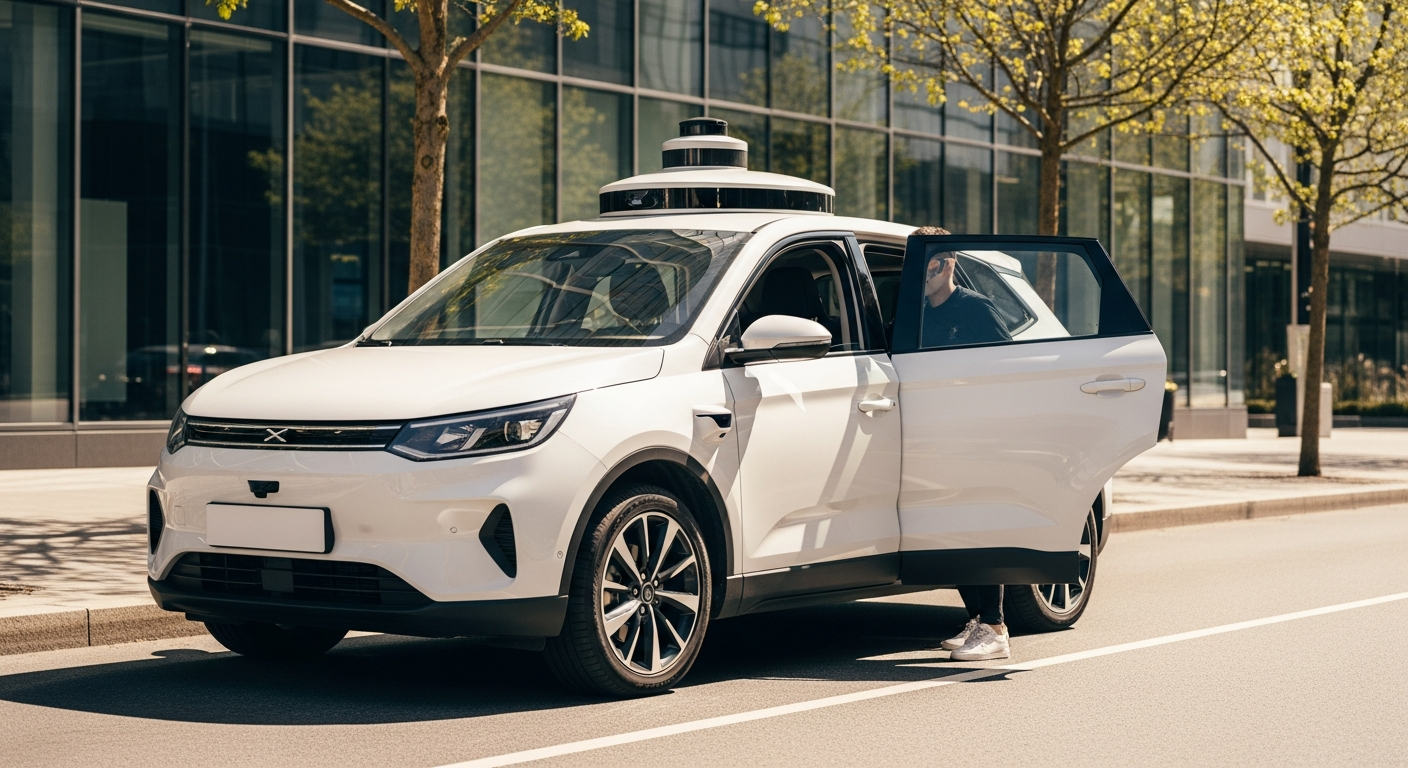
Why does this matter for a beginner robotics blog? Because Waymo’s cars are rolling demonstrations of the exact sensors you have been studying. Each vehicle stacks together cameras, radar, and the star of our LiDAR tutorial — spinning laser sensors that build a 360-degree distance map of everything around the car. Waymo’s whole bet is on sensor redundancy: if one sensor is confused (a camera blinded by sun glare, say), the others fill in.
The challenger: Tesla goes driverless in Austin — with cameras only
A couple of weeks earlier, on January 22, Tesla flipped on something it had long promised: unsupervised robotaxi rides in Austin, Texas, with no safety monitor in the car (TechCrunch; Electrek). At first only a few fully driverless cars are mixed into the broader fleet, with that ratio set to grow over time (Electrek).
Here is the part that puts these two stories in direct conversation. Tesla’s cars use vision only — eight cameras and a neural network, with no LiDAR and no radar (TechCrunch). Waymo loads up on lasers; Tesla deliberately leaves them off. That single difference is the LiDAR-vs-camera debate, and it is the same fault line we touched on back in Dispatch #3, when we covered the humanoid robots at CES 2026 — how much should a robot rely on cameras versus dedicated distance sensors?
In plain terms, the two camps split like this:
- Vision-first (Tesla’s view): Humans drive with two eyes and a brain, so a good-enough neural network plus cameras should be able to do the same — and cameras are cheap, so you avoid bolting expensive hardware onto every car.
- Sensor-redundancy (Waymo and most of the industry): Cameras guess depth from 2D images, while LiDAR measures it directly with light. Having an independent way to confirm “there is something solid 12 meters ahead” is a safety feature, not a luxury.
The plot twist: LiDAR isn’t expensive anymore
For years, the strongest argument for the camera-only camp was cost. LiDAR used to be eye-wateringly pricey — but that has changed fast, largely thanks to mass production in China. The average selling price of an automotive LiDAR sensor sat near $80,000 in 2016 and has fallen to roughly $200 by 2025 (Autoblog; SCMP). Major supplier Hesai has said it will sell an automotive-grade, long-range unit for under $200 (Autoblog), and prices for autonomous-trucking sensors are dropping on a similar curve (FleetOwner). (Treat the exact figures as ballpark — they vary a lot by sensor grade and source — but the direction is clear.)
That undercuts the “LiDAR is too expensive” argument considerably. A sensor that once cost more than the car is now in carry-on-luggage territory.
Connecting the dots
If you have followed the last three tutorials, you already understand the building blocks under both approaches.
LiDAR is literally the sensor at the center of this argument. As we covered, it fires laser pulses and times how long they take to bounce back, producing a map of distances — a 2D scan for the little spinning units, or a full 3D point cloud (a dense cluster of measured 3D points) for the bigger automotive sensors. The disagreement between Waymo and Tesla is really a disagreement about whether you need that direct distance measurement at all.
IMUs matter the moment a sensor is unsure. An Inertial Measurement Unit senses acceleration and rotation, which lets a car keep estimating its own motion — a trick called dead reckoning — even during the split second a camera is blinded or a tunnel swallows the GPS signal. It is the inertial “inner ear” that smooths over gaps in what the cameras and LiDAR report.
PID control is what turns all that sensing into smooth motion. Once the car has decided on a path, a feedback controller in the spirit of PID continuously compares where the car is against where it should be and nudges the steering and speed to close the gap — the same error-correcting loop you built for a motor, just keeping two tons of car gently centered in its lane instead of a wheel at 100 RPM.
A worthwhile side note for context: the funding frenzy is not limited to cars. Humanoid robotics — the theme of our last Dispatch — keeps drawing huge sums too, with Figure among the names that have crossed the billion-dollar mark (The Robot Report). But this week the spotlight clearly belongs to the robotaxis.
Next week we step away from the news and get our hands dirty with 3D printing for robots — how to design and print your own parts, brackets, and enclosures.
The takeaway
To present both sides fairly: Tesla and its supporters argue that humans drive with vision alone, so a sufficiently capable camera-and-neural-network system should too, and that simpler hardware scales more cheaply (TechCrunch). Waymo and much of the industry counter that an independent, direct distance measurement from LiDAR adds a safety margin that inferred depth cannot match — which is why their cars carry the full sensor suite (Waymo blog).
Our read: the strongest case for going camera-only has always been cost, and that case is weakening as automotive LiDAR slides toward $200 a unit. We are not calling a winner — Tesla’s Austin rollout is real and expanding, and only long-term safety data will settle which architecture is best — but when the “expensive extra sensor” stops being expensive, “why not keep it as a backup?” gets harder to argue with. For now, both bets are still live, and that is exactly what makes this race worth watching.
Sources
- Waymo raises $16 billion investment round — Waymo blog
- Waymo raises $16B to scale robotaxi fleet to London, Tokyo — TechCrunch
- Waymo announces $16 billion funding round — CNBC
- Tesla launches robotaxi rides in Austin with no human safety driver — TechCrunch
- Tesla starts robotaxi rides without safety monitor in Austin — Electrek
- China made LiDAR cheap, and automakers are racing to use it — Autoblog
- China’s low-cost EVs to be fitted with LiDAR systems — South China Morning Post
- LiDAR costs for autonomous trucks are dropping fast — FleetOwner
- Figure AI passes $1B in Series C funding — The Robot Report