Dispatch #3: CES 2026 and the Year Humanoids Reported for Work
Our CES 2026 roundup: Boston Dynamics' electric Atlas, Nvidia's GR00T, and a wave of cheaper humanoids that are finally leaving the demo stage for real shifts.
Welcome back to The Robotics Dispatch, the every-fourth-week news break where we set the tutorials aside and look at what’s actually happening in the robotics world. This is issue #3, and there was only one place to point the camera this fortnight: CES 2026 in Las Vegas (January 6–9), the giant consumer-electronics show where this year humanoid robots were less a sideshow than the main act.
The headline you’ll see everywhere is some version of “the robots have arrived.” That’s half true. The more interesting story is a quieter shift underneath the hype: a handful of these machines stopped being stage demos and started doing paid, repetitive work. Let’s look at who actually shipped, who promised, and how to tell the difference.
The lead: Boston Dynamics’ electric Atlas goes to work
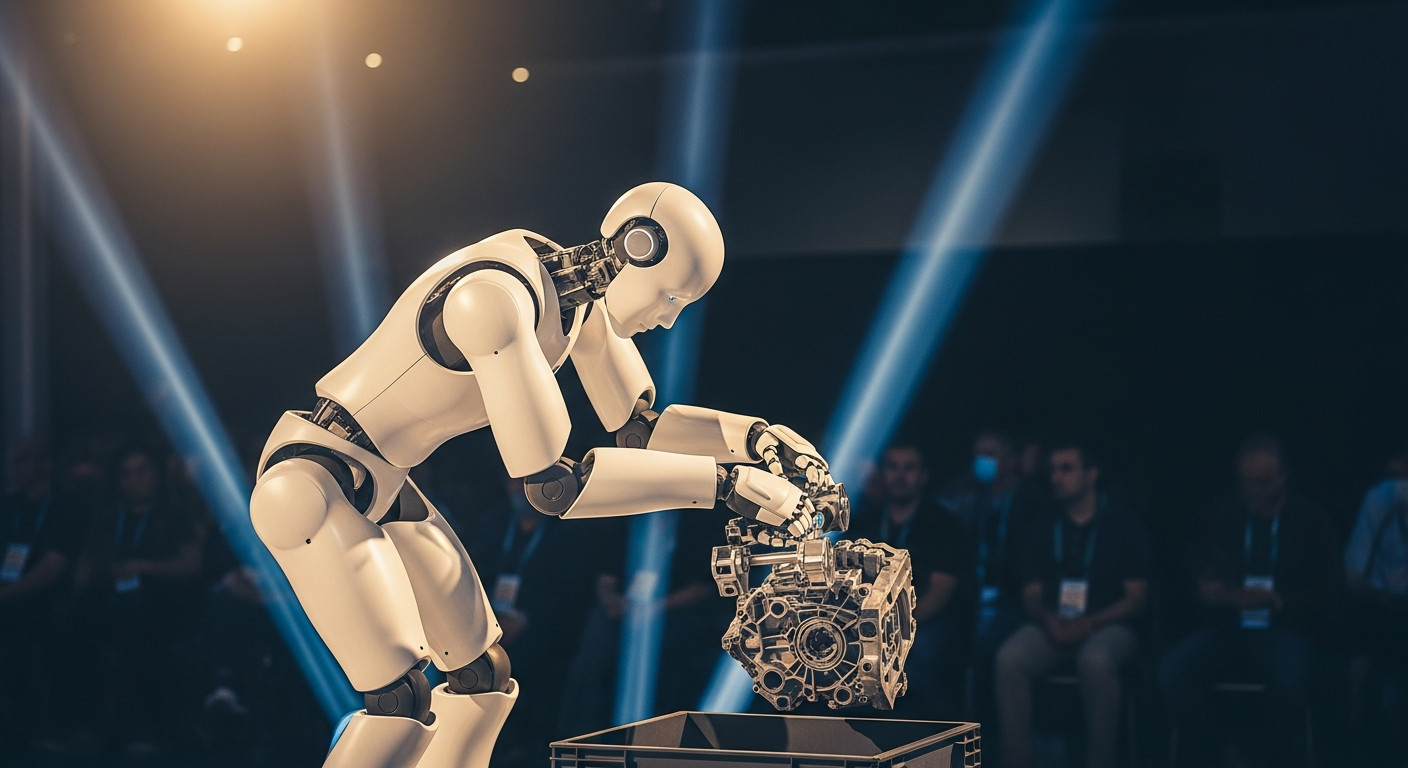
The best-verified story out of CES is Boston Dynamics’ all-electric Atlas. The hydraulic Atlas was the one famous for backflips in YouTube videos; the new version replaces all that fluid-powered muscle with electric motors at every joint, which makes it quieter, more reliable, and far easier to mass-produce. (“Electric actuation” just means electric motors do the moving instead of pressurized hydraulic fluid.)
What makes this newsworthy isn’t the robot — it’s the customers. Boston Dynamics says every Atlas unit it builds in 2026 is already committed, shipping to two places: Hyundai’s new Robot Metaplant Application Center (RMAC) and Google DeepMind (The Robot Report). Hyundai (which owns Boston Dynamics) confirmed at its own CES press event that product-version Atlas units have begun field tests at its Metaplant America factory in Georgia, with the goal of high-precision parts sequencing “at scale” by 2028, and a longer-term aim of a U.S. line producing up to 30,000 robot units a year (Hyundai newsroom).
The Google DeepMind half is where the AI lives. DeepMind is supplying its Gemini Robotics foundation models — the same family of “learned” models we’ll come back to in a moment — so Atlas can adapt to tasks instead of running only pre-programmed motions (The Robot Report). On the spec sheet, the production Atlas stands about 1.8 m tall, has 56 degrees of freedom (independent joints it can move), and can lift roughly 110 lb (about 50 kg) (Hyundai newsroom). Pricing was not disclosed.
Nvidia hands every robot maker the same brain
If Atlas was the marquee hardware, Nvidia supplied the software theme. CEO Jensen Huang used his keynote to argue robots are having their “ChatGPT moment,” and backed it with a stack of new open models for what Nvidia calls physical AI — AI that controls things in the real world rather than just chatting on a screen (CNBC).
The two names worth knowing are Isaac GR00T N1.6, an open “vision-language-action” model that turns what a robot sees and hears into full-body motion commands, and Cosmos Reason 2, a model for the reasoning and planning that sits above it (Nvidia newsroom). Nvidia lined up a long list of partners building on this — Boston Dynamics, NEURA Robotics, Agibot, LG and others — many of them dropping Nvidia’s Jetson Thor computer into their robots as the on-board brain (Nvidia newsroom).
There’s a thread here back to our last issue. In Dispatch #2, “robots that see and learn,” we talked about robots that are trained from examples rather than hand-coded line by line. GR00T and Gemini Robotics are exactly those learned models — and at CES 2026 they showed up baked into shipping (or nearly-shipping) hardware rather than living in a research paper.
The price war: humanoids under $30k
The other big CES story was cost. Unitree, the Chinese firm that shipped an estimated 5,500-plus humanoids in 2025 (around 38% of the global total for the year), continued to undercut everyone, with its G1 model listed from about $16,000 and a smaller R1 around $4,900 (Interesting Engineering; Unitree). These are research-and-developer machines, not household helpers — but the prices reframe what “a humanoid” costs. EngineAI, meanwhile, showed its T800 and reportedly named a roughly $25,000 starting price with first shipments targeted for mid-2026 (Interesting Engineering). Treat the newer prices and dates as approximate until units actually arrive.
Here are a few of the humanoids that drew attention, with values marked approximate where they’re vendor figures or pre-launch estimates:
| Robot | Maker | ~Height | ~Price | Ship target |
|---|---|---|---|---|
| Atlas (electric) | Boston Dynamics | ~1.8 m | Not disclosed | 2026 units committed (Hyundai, DeepMind) |
| G1 | Unitree | ~1.3 m | from ~$16,000 | Shipping now |
| R1 | Unitree | ~1.2 m | ~$4,900 | Shipping now |
| T800 | EngineAI | n/a (vendor) | ~$25,000 (approx.) | ~Mid-2026 (stated) |
| Gen 3 humanoid | NEURA Robotics | n/a (vendor) | Not disclosed | Announced at CES |
Connecting the dots: open standards and humble parts
It’s easy to look at a $1.5M-class research humanoid, or even a $16k one, and assume it runs on exotic technology. Mostly, it doesn’t.
A great deal of this hardware talks to itself using ROS 2, the open-source robot “middleware” we covered two tutorials back. Middleware is the plumbing that lets a robot’s many programs — vision, planning, motor control — pass messages to each other in a standard way. That standardization is a quiet reason the CES floor moved so fast this year: a startup can buy off-the-shelf arms, an Nvidia brain, and an open model, and wire them together over a common language instead of inventing everything from scratch.
And underneath the learned models and the glossy chassis, you’ll find the same humble components you’ve already met. The hands and torso are studded with simple range and proximity sensors — close cousins of the ultrasonic sensors you wired up to measure distance — so the robot knows when a gripper is near a part. The dozens of motor controllers, sensors, and tiny chips inside each limb chatter over the same chip-to-chip buses we just studied, I2C and SPI. A humanoid is, in large part, a very dense version of the bench project you’ve been building.
Demo, pilot, or shipping?
Worth holding onto as the headlines roll in: there’s a real gap between a robot that dances flawlessly on a stage and one that does reliable, paid work for a customer. Several recaps sorted CES humanoids into three buckets — polished prototypes (impressive videos, not yet orderable), real-world pilots (running at a partner’s site under supervision), and production systems you can actually buy and deploy (RoboStore). The lines between buckets are fuzzy and sources disagree on where individual robots land, so it’s fair to be a little skeptical of any “it’s here” claim. The genuinely shipped-and-working examples remain narrow and repetitive: Atlas sequencing parts in a factory cell, or Agility’s Digit moving totes in a warehouse — useful, bounded jobs, not general helpers (Interesting Engineering).
Next week we’re back to tutorials, and it’s a fitting follow-on: LiDAR, the spinning laser depth-sensor that lets many of these machines (and self-driving cars) build a 3D map of the room around them. After CES, you’ll recognize it on half the robots in this issue.
The takeaway
Our read: CES 2026 was a real inflection point, but mostly a commercial one rather than a sci-fi one. The eye-catching shift isn’t smarter robots — it’s that the boring parts (committed orders, factory pilots, sub-$30k price tags, shared open software) are finally lining up, which is what turns a demo into a product. We’d weight the verified deployments — Atlas at Hyundai, Digit at warehouses — far more heavily than the viral clips, and assume most “available now” humanoids are still developer kits for a while yet. The interesting question for next year isn’t whether robots can walk and talk; it’s whether anyone keeps paying them to show up.
Sources
- Boston Dynamics / Google DeepMind reunite on next-gen Atlas — The Robot Report
- Hyundai Motor Group AI Robotics strategy at CES 2026 (Atlas, RMAC, Metaplant, 30,000-unit target) — Hyundai newsroom
- Nvidia releases new physical AI models (Isaac GR00T N1.6, Cosmos Reason 2) as partners unveil robots — Nvidia newsroom
- Humanoid robots take over CES in Las Vegas — CNBC
- 9 humanoid robots at CES 2026 (Unitree shipments, Agility Digit, pricing) — Interesting Engineering
- EngineAI T800 at CES 2026 — Interesting Engineering
- Unitree G1 product page — Unitree
- Humanoids at CES 2026: prototype vs pilot vs production — RoboStore